


















Your go-to guide for Toronto student life.

The Sustainable Student: Waste-Less, Stress-Free
Published September 11, 2026 by Nina Popovic
As students we have certain priorities that come first: our academics, our jobs, maintaining our social lives. Striving for sustainability just might not happen naturally, especially when we’re busy and don’t have the money to spend on greener alternatives to our usual conveniences.
Toronto is not a cheap city to live in! Unfortunately, pursuing a more environmentally-conscious lifestyle means making major changes and sacrifices that student life might not allow.
Still, it’s important for everyone to chip in where they can. It all comes down to consumption, how much we waste, and building healthier habits. If you’re looking to start being a more sustainable student without making major life changes all at once, here are some simple ways you can waste less, stress-free!
1. Invest in Your Own Containers & Cutlery
The ease of convenience is a main contributor to our issue of waste. On a hot summer day, it’s easy to just walk into your closest Tim Hortons and order an iced cap. Takeout containers are practical, but disposable. By investing in your own reusable containers or cutlery, you’re not only cutting down on your waste, but also saving if you know where to look:
- Bulk Barn: Bring your reusable containers or cloth bags for a 15% off discount on your purchase every Sunday.
- Tim Hortons and Starbucks: Enjoy 10 cents off your beverage when you bring a clean, reusable cup or mug. You can still enjoy your iced cap!
- Dark Horse: Bring a reusable cup and get 25 cents off your beverage.
Don’t be afraid to ask your local coffee shop if they do discounts on reusable cups; the worst they can say is no! Even if you don’t get a deal, it’s still a good practice to bring your own mug. It’s actually a Toronto bylaw for all coffee shops to accept reusable cups, as long they meet the requirements.
2. Support Your Local Library
There are few things better than the feeling of getting lost in your favourite book, except the feeling of getting lost in your book that you didn’t have to pay for. While it is sometimes necessary to own your own textbook for class, usually my regular books will be read once or twice before they begin collecting dust. Instead of buying a new one every time, support your local library and enjoy the many wonderful services they have to offer.
There are 100 Toronto Public Library branches across the city. So long as you live, work, or go to school in the City of Toronto, you qualify for a free library card! All you need to do is visit an open library branch with a valid name and address identification. With your card, you can take out books, eBooks, movies, music, and access research databases as well as eLearning sources. Instead of buying new, enjoy something borrowed that will eventually be recirculated and enjoyed by someone else.
Find out how to get a TPL card for free.
3. Recycle For a Reward
If you want to be sure that your empty alcohol bottles are being properly recycled, look no further than The Beer Store, a proud partner of the Ministry of Finance in the Ontario Deposit Return Program (ODRP). Their waste reduction program covers any containers over 100 mL sold from any LCBO stores, licensed grocery/convenience stores, LCBO Convenience Outlets, Ontario wineries, distilleries, or brewery retail establishments.
Basically, there’s not a lot that they don’t accept. Depending on its volume, each container or can is valued as 10 or 20 cents each; the more you bring to recycle, the more they pay you back! So if you’re having friends over this summer to enjoy cold beer, ask them to save their cans afterward and bring them to your closest Beer Store for a reward.
If you’re interested, you can find out more about the value of each container based on its size on the Beer Store’s website.
4. Shop Secondhand
Thrifting has grown in popularity in recent years, and for good reason. Not only is it (usually) a cheaper alternative to buying brand-new clothes or accessories, but it’s a less wasteful way to curate your own style.
There’s no shortage of second-hand stores in Toronto. Of course, there are the chains you might be already familiar with: Value Village, The Salvation Army, Goodwill, and Plato’s Closet. These establishments also accept donations, so if you have clothes that you’ve outgrown or household items you just can’t stand to look at anymore: they’ll take them. As the saying goes: one man’s trash is another man’s treasure! Salvation Army even gives you a 20% coupon if you drop off your haul at their Donor Welcome Centre (redeemable at certain locations).
As students, we’re often searching for specific books that we need for our classes and research. If the library books are all on loan and you need the book immediately, there are several websites that sell used books at a very discounted price.
- Thriftbooks has over 13 million titles to choose from and sends your order in 100% recyclable packaging.
- AbeBooks has offered more than used books, but also fine art and collectibles since 1995.
Rummage and garage sales are also a great way of shopping second-hand and are always much cheaper than the chain stores. In Toronto, garage sale season usually starts up in the springtime and lasts until it starts getting cooler in the fall. You typically won’t see garage sales in the heart of downtown, but if you find yourself in the more suburban parts of the GTA on a weekend, keep an eye out for street postings with the where and when.
Pro Tip: When going to these sales, it’s also better to bring cash.
5. Save Water: Feed a Plant
Taking care of a plant doesn’t have to be so daunting. Anyone can do it (even busy students!) as long as they have water, which is a resource so quickly wasted in a large metropolis like Toronto.
Don’t pour your guest’s leftover water down the sink; give it to your plant! Trust me, the plant won’t care if it was meant for someone else. Unlike a restaurant, you can decide to re-serve your leftovers… to your aloe vera.
Keep a watering can near your sink so that instead of dumping your water down the drain, you can keep growing your own little garden. Not only will your living space be greener (a benefit for both your mental and physical health), but you could potentially grow some of your own food. Even in a winter climate like Canada’s, there are herbs and leafy greens that will grow successfully indoors.

6. Plan Your Meals: Leftover Life Savers
It’s difficult to go cold turkey (pun intended) and completely cut meat from your diet if you’re not accustomed to it. Red meat is a particularly important source of protein and iron, which is unfortunate considering how detrimental it is to biodiversity destruction and greenhouse gas emissions. A plant-based diet is achievable with proper planning; it just might require time you might not have right now.
Meal planning often has this bad image of identical containers with the same dish packed inside your fridge. But it doesn’t need to be like that. Save time by only grocery shopping for what you need once a week. When you sit down to write your shopping list, think about three or four larger meals you can make that week that will last you longer than a single sitting. If possible, meals that have overlapping ingredients so that even your ingredients aren’t spent all on one.
If you don’t know where to start, the good news is that the Internet has countless meal-planning toolkits to look for inspiration. The Heart and Stroke foundation posts tons of recipes, from salads to salsas to sandwiches, as well as six suggested short-cuts to make your meals faster.
Start your plant-based cooking but remember there are nutrients you need that you can’t get from eating only fruits and vegetables. As someone with an iron deficiency, I’m always on the lookout for no-red-meat meals that are still hearty and healthy. Here are some recipes I’m excited to try soon, that will definitely leave me with leftovers for at least a few days after:
Don’t be afraid of having leftovers. When you’re at a restaurant, be the friend that asks to take the food they didn’t finish home. If you just ask, most of the time, your waiter will bring you a container (a container you can then reuse!) and now you have a meal or a snack to enjoy later. Sure, it might not be quite as fresh as when it was served to you, but if you’ve got a fridge, microwave, and/or oven, you can make it almost as good as new!
7. Invest in Energy-Efficient Appliances
You don’t need to buy a new energy-efficient fridge to reduce your electricity consumption; simple household appliances can be a way of saving energy and effort:
Pressure Cooker
Pressure cooking is significantly more energy efficient than using many pots on different burners. All the cooking steam is trapped inside the sealed pot, where the pressure and temperature rise. Because they are designed for one-pot recipes, pressure cookers require barely any cooking or cleaning space, reducing cooking time by 70%! It’s perfect for busy students who are looking for more sustainable food prep practices.
You can find pressure cookers at stores selling kitchen appliances like Canadian Tire and Kitchen Stuff Plus, or keep an eye out for one the next time you’re at a rummage sale (they’re much cheaper too!).
Rechargeable Batteries
Move away from disposable batteries and invest in rechargeable ones. Not only are you avoiding spending on single-use products, but you’re also minimizing the number of batteries going straight to the landfill. A single rechargeable battery can replace hundreds of disposable ones!
8. Trash to Treasure: Upcycle
Even when we switch over to reusable mugs and containers, unsustainable packaging is just an inevitability. Cardboard, bubble wrap, and plastic coating are just unfortunately a part of buying anything new in-store or online. You can’t control the package of a product you’ve bought, but you can control what you do with it afterwards.
Upcycling is an easy habit to get into. It’s great because you don’t need to buy any materials; it’s all about using what you already have at your disposal. If you aren’t bringing your aluminum can to The Beer Store, turn it into a storage container for your art or office supplies. Empty plastic bottle? Use it to grow your garden on a windowsill. Upcycling is not only an outlet for creativity, but it’s a chance to give your “garbage” a second life.
If you’re not sure where to start, here are some easy upcycling crafts to start you off:
- Plastic Water Bottles Flowers – The good news is: they’ll never die.
- Lotion Bottle Cell Phone Holder – Create a comfy little nook for your phone.
- T-Shirt to Tote Bag: No sewing, no problem.
9. Use Active Transportation
Active transportation means using your own power as a human to move yourself from one place to another. Whether it’s walking, riding your bicycle, skateboarding, or rollerblading, you aren’t relying on a vehicle. In downtown Toronto, it’s easier (and probably faster in some cases) to use active transportation or public transit for your commute than to drive in a car. While winter roads can be hazardous, bike lanes often covered in snow, when it’s not icy, there’s no excuse not to try!
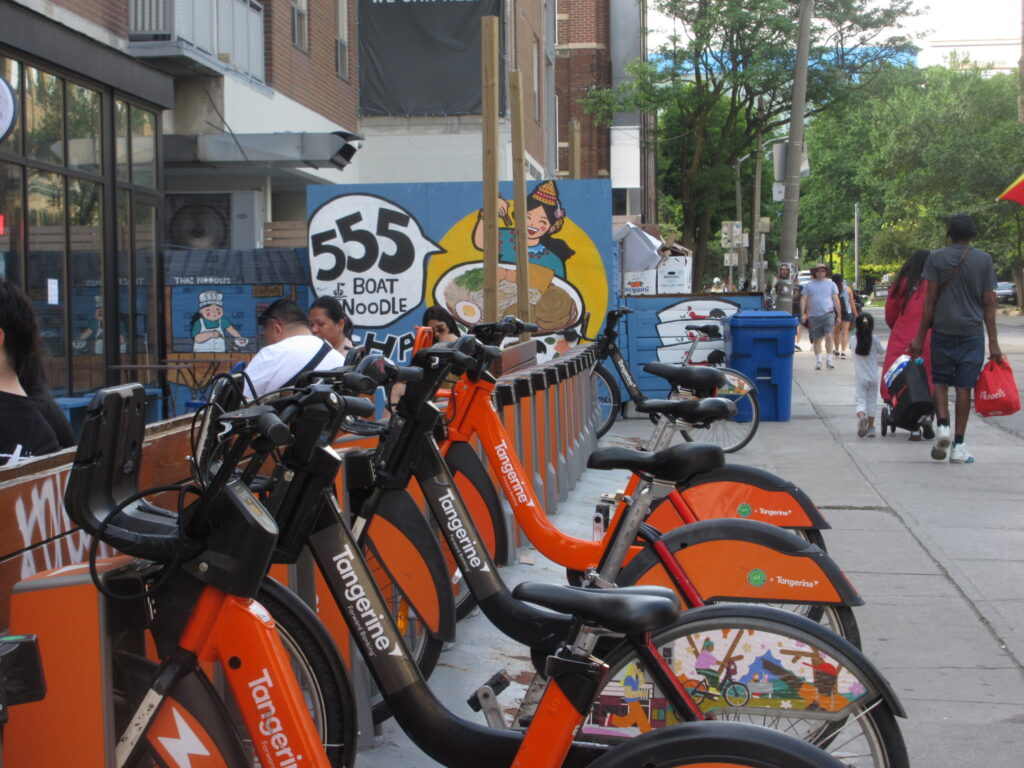
For anyone interested in getting into cycling, Toronto has options for bike rentals that offer price reductions for students. Not only is Bike Share Toronto conveniently accessible 24/7 with over 10,000 bikes and 1,000 stations across the city, but they also offer a 20% discount for students. It’s as simple as downloading the app, purchasing your pass, choosing your bike or E-bike from a station and returning it to one afterwards. Explore what Bike Share has to offer, create an account, and get pedaling.
And of course, there’s the benefit for you: healthy physical activity, which has been proven time and time again to improve mental health too. While you can, soak up the sun and stretch your legs; the planet will thank you!
Don’t Forget:
At the end of the day, it’s important to remember that the future of the planet doesn’t rest entirely on your shoulders. Don’t beat yourself up for getting an iced coffee in a plastic cup from time to time; we need larger systematic changes to make a real difference.
As a community, we need to consume less and recycle more if there’s any hope of implementing a circular economy. By starting with small actions like the ones in this article, you can train yourself to be less wasteful and encourage others to do the same.